Fluoride-Free Toothpaste May Not Be Enough To Stop Cavities, Experts Warn
The idea that just brushing teeth doesn't stop cavities has largely been accepted among researchers for decades, but not always by the public.
Dental health experts worry that more people are using toothpaste that skips the most important ingredient — fluoride — and leaves them at a greater risk of cavities.
Most toothpastes already contain fluoride. While health authorities recognize fluoride as a cavity blocker, the internet is dotted with claims, often from "natural'' toothpaste marketers and alternative medicine advocates, that fluoride-free toothpaste also prevents cavities.
Dental authorities disagree.
"It's really important to debunk this idea that brushing your teeth stops decay. You need to have the fluoride,'' said Damien Walmsley, a scientific adviser to the British Dental Association and dentistry professor at the University of Birmingham.
That view was underscored this week by an article in the dental journal Gerodontology that reviewed the scientific literature on cavities. Its primary conclusion is that, without fluoride, oral hygiene efforts have "no impact'' on cavity rates.
Value of fluoride widely accepted for decades
The idea that just brushing teeth doesn't stop cavities has largely been accepted among individual researchers for decades, but not always by the public. Dentists generally recommend fluoride for cavity fighting, but even some of them continue to believe that the mechanics of wiping your teeth clean of plaque also reduces cavities. The review findings, published Monday, gave pause to at least one dentist.
"It violates certain principles we've been taught and that we teach and that we believe,'' said Richard Niederman, a dentist and professor at New York University who saw an advance copy of the study and found the findings credible. "What it says to me is that the toothbrush is just a delivery system.''
Few studies of the question have been carried out in recent years because the value of fluoride has been widely accepted for decades. In the review, University of Washington researchers looked for high-quality studies since 1950 and found just three. They were carried out in the U.S. and Great Britain and published from 1977 to 1981. They involved a total of 743 children aged 10 to 13 years who flossed and brushed for up to three years.
When the studies were evaluated statistically as a whole, there was no significant cavity reduction from simply brushing or flossing without fluoride.
Dentist J. Leslie Winston, oral care director for Crest-toothpaste maker Procter & Gamble, said the review "serves as an important reminder.''
"Despite a large body of scientific evidence, there are growing numbers of consumers who believe that all toothpastes are the same and that as long as you clean your teeth effectively with a toothbrush or other device which cleans in-between the teeth, you can prevent decay,'' he said in a statement.
The market share for fluoride-free toothpaste is closely held company data. Industry sources estimate it at no more than 5 per cent of all toothpaste sold, but with projected growth of over 5 per cent annually. On Monday, Tom's of Maine antiplaque and whitening toothpaste, which is fluoride-free, was listed as the second-best selling toothpaste on Amazon's online buying platform.
I don't think fluoride makes a difference at all.Gerald Curatola, Revitin founder
Paul Jessen, a brand manager at Tom's of Maine, said "the products that don't contain fluoride that we offer do not promise that benefit'' to fight cavities. He said his company's customers generally understand this.
Yet customer comment on Amazon's website sometimes indicates otherwise, with many reviews insisting that the company's fluoride-free toothpaste does fight cavities. "If you brush regularly with or without fluoride, you reduce the risk of cavities,'' asserts one customer.
Oral care companies themselves also stray into such claims. The website of Revitin non-fluoride toothpaste says it "strengthens your teeth against tooth decay.''
Gerald Curatola, the dentist who founded Revitin and now serves as chief science officer, called the review "misleading.'' He said that the latest science suggests that a healthy mix of oral bacteria is key to dental health. "I don't think fluoride makes a difference at all,'' he said.
However, referring to his company's decay-fighting claim, he added: "After this call, I'm probably going to remove that from the website, because I don't think that should be on there, because I didn't know that was on there.''
Benefits of brushing without fluoride may be too small to detect
Jeff Davis, the CEO of Sheffield Pharmaceuticals that sells toothpaste with and without fluoride, said it's "pretty established'' that fluoride is what helps reduce cavities. But he said some people worry about the harmful effect of too much fluoride and so choose fluoride-free toothpaste.
Even without fluoride, dentists say there's some value in brushing. Philippe Hujoel, the dentist and University of Washington professor who led the dental review, said oral hygiene without fluoride might produce real cavity-fighting effects too small to detect in a study, or adults might conceivably benefit where the children in the studies did not.
And toothbrushing did reduce swollen gums in Hujoel's review. Brushing the teeth may also dislodge stuck food and help patients recover from oral surgery.
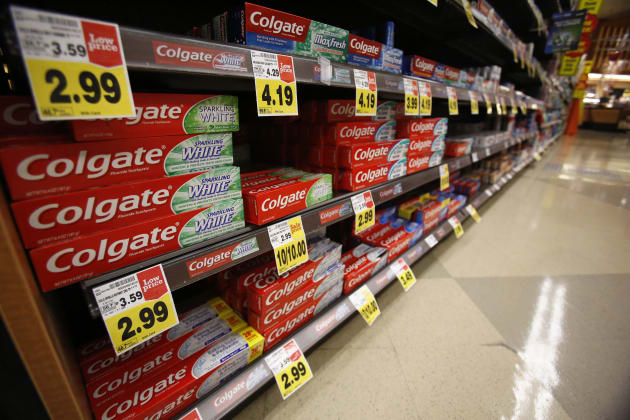
Mario Anzuoni / Reuters Colgate toothpaste is pictured on sale at a grocery store in Pasadena, California Jan. 30, 2014.
Dentist Matthew Messina, a spokesman for the American Dental Association, said mechanical brushing can also help avoid decay that sometimes forms, especially in older people, at the normally hidden roots of teeth, which was outside the scope of this review.
"The study is important,'' he added, "because the study is supporting what we've been contending for a long time.'' The ADA recommends using fluoride toothpastes.
The review also cited a 2009 analysis of studies involving 60,000 people that found fluoride rinse prevents cavities about as well as fluoride toothpaste.
In 2016, The Associated Press reported on the poor scientific evidence for the benefits of flossing. As a result, the federal government removed its long-standing flossing recommendation from Dietary Guidelines for Americans.
Alternate model for how cavities form
The review raises questions about how cavities form. Cavities have long been thought to develop in a poorly cleaned mouth when acids left by food start to wear away tooth enamel. The idea is that clean teeth do not decay. This review, though, argues for an alternate model: cavities grow in tiny crevices in the enamel that can't easily be reached with a toothbrush or dental floss alone.
Despite the clear benefit of fluoride, some studies have also challenged the belief that fluoridated drinking water stops dental decay as well as fluoride toothpaste or rinses. In any event, it makes sense to combine fluoridated water and dental products for amplified protection, said Niederman, the NYU dentist.
Some dentists also said the most effective way to prevent cavities is simply to reduce sugars in the diet.
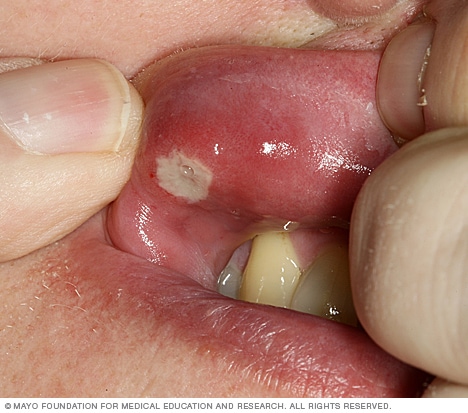
Canker sores, also called aphthous ulcers, are small, shallow lesions that develop on the soft tissues in your mouth or at the base of your gums. Unlike cold sores, canker sores don't occur on the surface of your lips and they aren't contagious. They can be painful, however, and can make eating and talking difficult.
Most canker sores go away on their own in a week or two. Check with your doctor or dentist if you have unusually large or painful canker sores or canker sores that don't seem to heal.
Symptoms
Most canker sores are round or oval with a white or yellow center and a red border. They form inside your mouth — on or under your tongue, inside your cheeks or lips, at the base of your gums, or on your soft palate. You might notice a tingling or burning sensation a day or two before the sores actually appear.
There are several types of canker sores, including minor, major and herpetiform sores.
Minor canker sores
Minor canker sores are the most common and:
Are usually small
Are oval shaped with a red edge
Heal without scarring in one to two weeks
Major canker sores
Major canker sores are less common and:
Are larger and deeper than minor canker sores
Are usually round with defined borders, but may have irregular edges when very large
Can be extremely painful
May take up to six weeks to heal and can leave extensive scarring
Herpetiform canker sores
Herpetiform canker sores are uncommon and usually develop later in life, but they're not caused by herpes virus infection. These canker sores:
Are pinpoint size
Often occur in clusters of 10 to 100 sores, but may merge into one large ulcer
Have irregular edges
Heal without scarring in one to two weeks
When to see a doctor
Consult your doctor if you experience:
Unusually large canker sores
Recurring sores, with new ones developing before old ones heal, or frequent outbreaks
Persistent sores, lasting two weeks or more
Sores that extend into the lips themselves (vermilion border)
Pain that you can't control with self-care measures
Extreme difficulty eating or drinking
High fever along with canker sores
See your dentist if you have sharp tooth surfaces or dental appliances that seem to trigger the sores.
Causes
The precise cause of canker sores remains unclear, though researchers suspect that a combination of factors contributes to outbreaks, even in the same person.
Possible triggers for canker sores include:
A minor injury to your mouth from dental work, overzealous brushing, sports mishaps or an accidental cheek bite
Toothpastes and mouth rinses containing sodium lauryl sulfate
Food sensitivities, particularly to chocolate, coffee, strawberries, eggs, nuts, cheese, and spicy or acidic foods
A diet lacking in vitamin B-12, zinc, folate (folic acid) or iron
An allergic response to certain bacteria in your mouth
Helicobacter pylori, the same bacteria that cause peptic ulcers
Hormonal shifts during menstruation
Emotional stress
Canker sores may also occur because of certain conditions and diseases, such as:
Celiac disease, a serious intestinal disorder caused by a sensitivity to gluten, a protein found in most grains
Inflammatory bowel diseases, such as Crohn's disease and ulcerative colitis
Behcet's disease, a rare disorder that causes inflammation throughout the body, including the mouth
A faulty immune system that attacks healthy cells in your mouth instead of pathogens, such as viruses and bacteria
HIV/AIDS, which suppresses the immune system
Unlike cold sores, canker sores are not associated with herpes virus infections.
Risk factors
Anyone can develop canker sores. But they occur more often in teens and young adults, and they're more common in females.
Often people with recurrent canker sores have a family history of the disorder. This may be due to heredity or to a shared factor in the environment, such as certain foods or allergens.
Prevention
Canker sores often recur, but you may be able to reduce their frequency by following these tips:
Watch what you eat. Try to avoid foods that seem to irritate your mouth. These may include nuts, chips, pretzels, certain spices, salty foods and acidic fruits, such as pineapple, grapefruit and oranges. Avoid any foods to which you're sensitive or allergic.
Choose healthy foods. To help prevent nutritional deficiencies, eat plenty of fruits, vegetables and whole grains.
Follow good oral hygiene habits. Regular brushing after meals and flossing once a day can keep your mouth clean and free of foods that might trigger a sore. Use a soft brush to help prevent irritation to delicate mouth tissues, and avoid toothpastes and mouth rinses that contain sodium lauryl sulfate.
Protect your mouth. If you have braces or other dental appliances, ask your dentist about orthodontic waxes to cover sharp edges.
Reduce your stress. If your canker sores seem to be related to stress, learn and use stress-reduction techniques, such as meditation and guided imagery.
Children need to stop sucking their thumb and using a pacifier between ages 2-4, before the adult teeth start to erupt. Otherwise an open bite, as shown, may develop.
Gum disease having devastating impact on general health and well-being warn dentists
Credit: University of BristolA new report has revealed that the number of people affected by tooth decay and gum disease is having a widespread and devastating impact not only on patients mouths but also on their general health and wellbeing, particularly in the older population.
The study, led by an international team of periodontists including researchers at the Bristol Dental School at the University of Bristol, reviewed all available data, publishing 15 systematic reviews on the evidence and published consensus findings, and found that ten per cent of the global population—743 million people—are affected by severe gum disease.
The findings were announced at the European Federation of Periodontology (EFP), the leading global voice on gum health and gum disease and published in the Journal of Clinical Periodontology, one of the most authoritative scientific publications in this field.
The papers were discussed at the XIII European Workshop of Periodontology, a joint workshop between the European Federation of Periodontology (EFP) and European Organization for Caries Research (ORCA). Left untreated, gum disease causes tooth loss and in its more severe forms, periodontitis which is independently associated with increased mortality rates due to a higher risk of atherogenic cardiovascular diseases, diabetes and related complications.
Professor Nicola West, Head of Restorative Dentistry and Director of the Clinical Trials Unit at Bristol Dental School and Hospital, who compiled the consensus findings, said: "The burden of these diseases is high and is increasing as the population ages. Both tooth decay and gum disease can lead to nutritional compromise and negative impact on self-esteem and quality of life. These findings help underline to dental professionals and the public the importance of oral health and that it is often an indicator of general health issues."
The study' recommendations include:
Dental professionals should be consulted regularly to prevent and treat caries and periodontal diseases effectively.
Bleeding gums are not normal. Dental professionals should be consulted immediately.
Periodontal disease should be seen as an indicator of general health issues.
Reducing sugar and starch intake levels and frequency is important in preventing periodontal disease and caries. Intake should be limited to mealtimes.
Brushing twice daily with fluoride toothpaste is essential and can also be supplemented with additional effective agents that reduce plaque, such as those found in mouthwash and toothpastes.
Wine polyphenols could fend off bacteria that cause cavities and gum disease
February 21, 2018 American Chemical Society
Credit: CC0 Public DomainSipping wine is good for your colon and heart, possibly because of the beverage's abundant and structurally diverse polyphenols. Now researchers report in ACS' Journal of Agricultural and Food Chemistry that wine polyphenols might also be good for your oral health.
Traditionally, some health benefits of polyphenols have been attributed to the fact that these compounds are antioxidants, meaning they likely protect the body from harm caused by free radicals. However, recent work indicates polyphenols might also promote health by actively interacting with bacteria in the gut. That makes sense because plants and fruits produce polyphenols to ward off infection by harmful bacteria and other pathogens. M. Victoria Moreno-Arribas and colleagues wanted to know whether wine and grape polyphenols would also protect teeth and gums, and how this could work on a molecular level.
The researchers checked out the effect of two red wine polyphenols, as well as commercially available grape seed and red wine extracts, on bacteria that stick to teeth and gums and cause dental plaque, cavities and periodontal disease. Working with cells that model gum tissue, they found that the two wine polyphenols in isolation—caffeic and p-coumaric acids—were generally better than the total wine extracts at cutting back on the bacteria's ability to stick to the cells. When combined with the Streptococcus dentisani, which is believed to be an oral probiotic, the polyphenols were even better at fending off the pathogenic bacteria. The researchers also showed that metabolites formed when digestion of the polyphenols begins in the mouth might be responsible for some of these effects.
More information: "Inhibition of Oral Pathogens Adhesion to Human Gingival Fibroblasts by Wine Polyphenols Alone and in Combination with an Oral Probiotic" Journal of Agricultural and Food Chemistry (2018). pubs.acs.org/doi/full/10.1021/acs.jafc.7b05466 Provided by: American Chemical Society